

On May 28, 2026, Anthropic dropped a quiet but consequential upgrade: Claude Opus 4.8. No flashy rebrand, no new pricing surprise — just a model that’s noticeably sharper, more honest, and a lot more useful for the kind of long, messy, multi-step work that real people (and real engineers) actually do.
If you’ve been using Opus 4.7, this is the upgrade you’ll feel almost immediately. If you haven’t, this is a good moment to start paying attention.
Here’s what’s new, why it matters, and what it means for builders, writers, analysts, and anyone whose job now includes “collaborating with an AI.”
TL;DR
- Claude Opus 4.8 launches with improvements across coding, reasoning, agentic, and knowledge-work benchmarks.
- Same price as Opus 4.7 — $5 / $25 per million input/output tokens.
- Effort control lets you choose how hard Claude thinks on each task.
- Dynamic workflows in Claude Code can now plan and run hundreds of parallel subagents for codebase-scale projects.
- Fast mode is now 3x cheaper than before.
- Honesty improvements: ~4x less likely to let flaws in its own code slip by unflagged.
What Actually Changed
1. It’s smarter where it counts
Opus 4.8 improves on Opus 4.7 across the board — coding, agentic skills, reasoning, and practical knowledge work. Anthropic published a full benchmark breakdown in the Claude Opus 4.8 System Card.
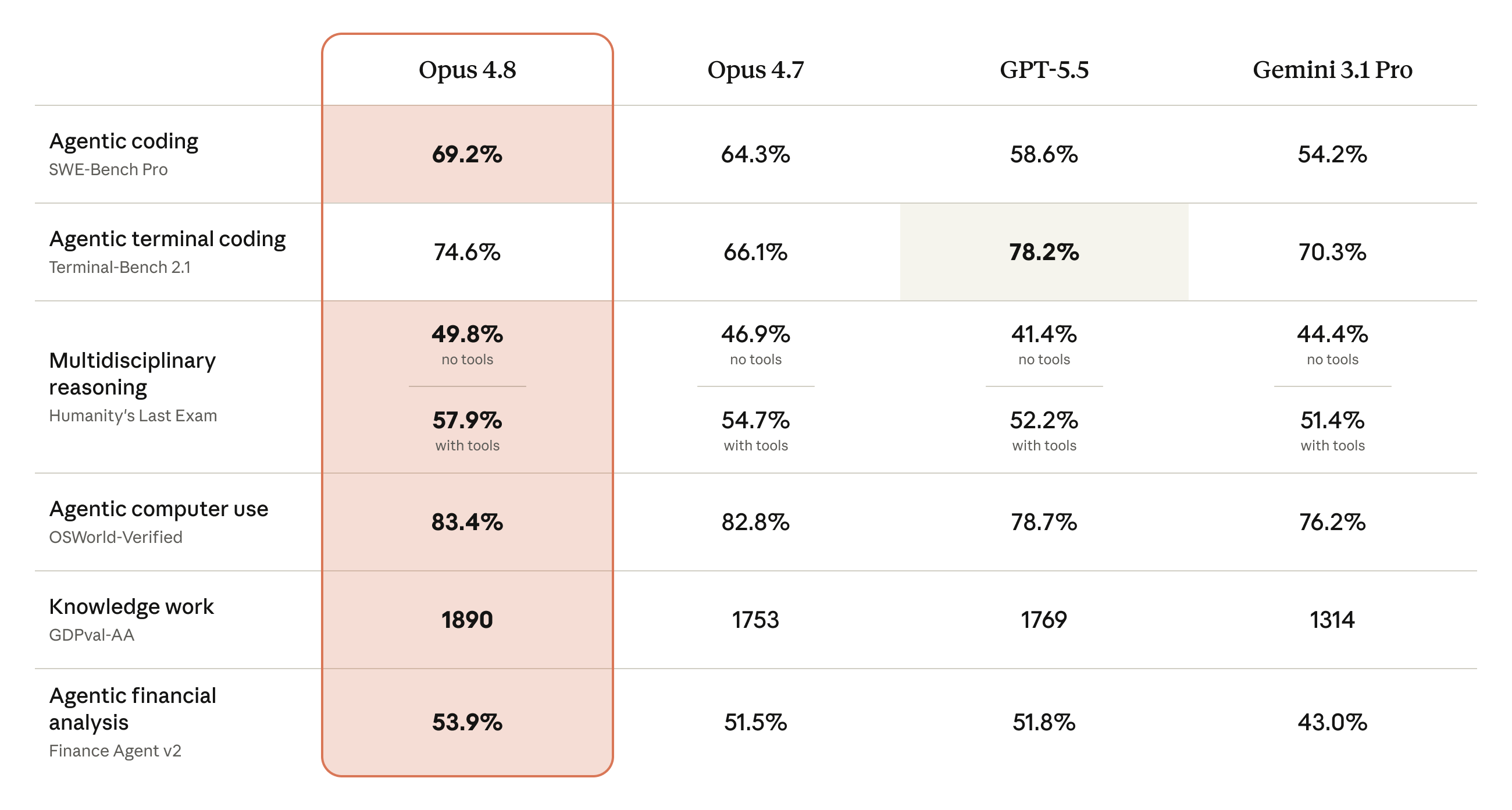
But the more interesting story is not the numbers. It’s how the model behaves.
2. It’s more honest — and that’s a bigger deal than it sounds
Anthropic claims Opus 4.8 is about four times less likely than its predecessor to let flaws in its own code pass without flagging them. In practice, that means fewer moments of “the script ran, all good!” followed by you discovering it silently skipped half the work.
Opus 4.8 is more likely to say: “Here’s what I did. Here’s what I’m unsure about. Here’s where you should look.”
That’s the difference between an assistant and a collaborator.
3. You’re now in charge of how hard it thinks
The new effort control sits right next to the model selector in claude.ai. You pick:
- High (default) — balanced quality and speed.
- Extra (
xhighin Claude Code) — for difficult or long-running async tasks. - Max — when you want it to spend whatever tokens it takes to get the right answer.
- Lower settings — when you want speed and want to conserve rate limits.
4. Dynamic workflows: Claude Code goes big
This is the headline feature for developers. Dynamic workflows let Claude Code plan a complex job, spawn hundreds of parallel subagents in one session, verify outputs, and report back.
Available in Claude Code for Enterprise, Team, and Max plans.
What Early Testers Are Saying
“In Claude Code, it asks the right questions, catches its own mistakes, pushes back when a plan isn’t sound, and builds up confidence around complex, multi-service explorations before making big changes.” — Tom Pritchard, Staff Engineer
“On our Super-Agent benchmark, Claude Opus 4.8 is the only model to complete every case end-to-end, beating prior Opus models and GPT-5.5 at parity on cost.” — Kay Zhu, Co-Founder & CTO
“Claude Opus 4.8 delivers the highest score recorded on our Legal Agent Benchmark, and is the first model to break 10% overall on the all-pass standard.” — Niko Grupen, Head of Applied Research
“Claude Opus 4.8 is the strongest computer-use and browser-agent model we’ve tested, scoring 84% on Online-Mind2Web.” — Miguel Gonzalez, Tech Lead
“It finished faster and produced richer, more information-dense outputs… The biggest differentiator was Opus 4.8’s tendency to proactively flag issues with the inputs and outputs of an analysis.” — Michael Ran, Sr. Investment Associate
The pattern across all the quotes: judgment, reliability, and self-awareness — not just raw capability.
The Quiet Win: Alignment
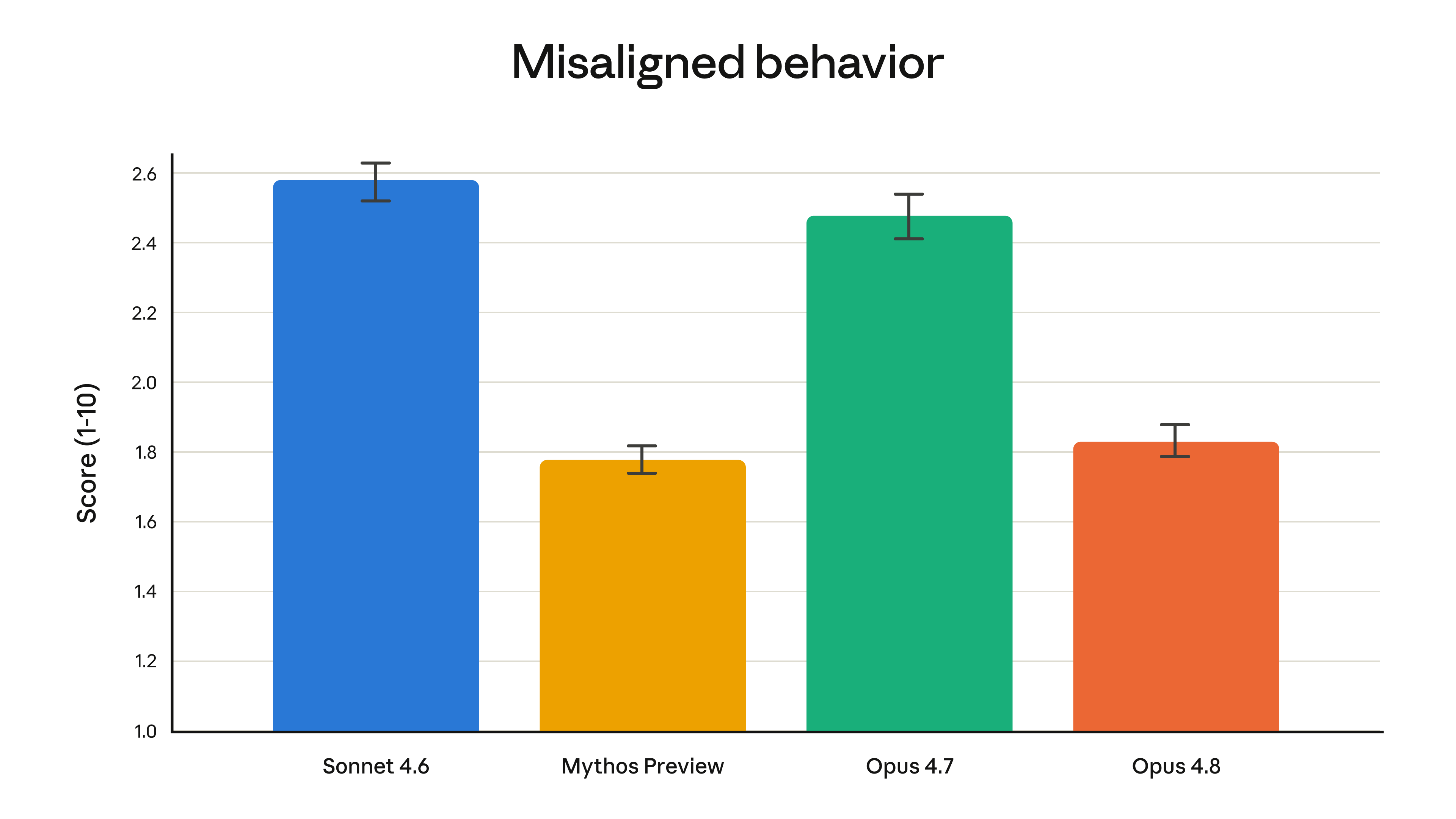
Anthropic’s Alignment team noted that Opus 4.8 “reaches new highs on our measures of prosocial traits like supporting user autonomy and acting in the user’s best interest.”
Misaligned behavior rates — things like deception or willingness to cooperate with misuse — are substantially lower than Opus 4.7. If you build products on top of Claude, this translates into fewer support tickets, fewer surprises, and more trust from your users.
Also Launching Today
- Messages API now accepts system entries inside the messages array. Developers can update Claude’s instructions mid-task without breaking the prompt cache — huge for agents that need to swap permissions or environment context on the fly.
- Fast mode is 3x cheaper than it was on previous models, and runs at 2.5x the standard speed.
- Effort control is available across all plans.
What’s Coming Next
- Cheaper models with Opus-level capability — they’re actively working on it.
- A new class of model above Opus — codenamed Claude Mythos, currently limited to a small set of organizations through Project Glasswing. General release is gated on stronger cyber safeguards, but it’s coming “in the coming weeks.”
Opus 4.8 is the new ceiling — for now.
Pricing and Availability
- Available today, everywhere.
- Standard pricing: $5 / million input tokens, $25 / million output tokens (unchanged from Opus 4.7).
- Fast mode: $10 / million input, $50 / million output.
- API model string:
claude-opus-4-8 - Docs: Claude API model overview
My Take
The Opus 4.8 release is about a model that finally feels like a steady collaborator — one that pushes back when your plan is shaky, flags its own uncertainty, and now lets you dial up the depth when you need it.
For developers, dynamic workflows is the headline — codebase-scale migrations in one session is genuinely new territory. For everyone else, the honesty improvements and effort control are the things you’ll feel every single day.
If you’ve been waiting for an AI that behaves less like an over-eager intern and more like a senior teammate who actually says “I’m not sure, let me check” — this is the upgrade.
Try It Yourself
- Claude.ai: claude.ai
- Read the announcement: Anthropic’s official post
- System card: Claude Opus 4.8 System Card
- Dynamic workflows post: Introducing Dynamic Workflows in Claude Code




Be the first to respond